
Marine Survey Online
  marinesurvey.com 
 Online Articles and Photos on Boats and Yachts Home

www.yachtsurvey.com
www.yachtsurvey.com
Over 160 Online Articles by David Pascoe

D. H. Pascoe & Co., Inc. Marine Surveyors, Publisher, Destin, Florida

Boat Buyers and Owners

Marine Survey Related Photo Library Books Book Order Contact Us


PHOTO LIBRARY
  BOOKS  


Surveying Fiberglass Power Boats by David Pascoe
Surveying Fiberglass Power Boats
2nd Edition
 
Marine Investigations by
Marine Investigations
 

M
A
R
I
N
E

S
U
R
V
E
Y

B
U
S
I
N
E
S
S


B
O
A
T

B
U
Y
E
R
S

G
U
I
D
E

 
Mid Size Power Boats by David Pascoe
Mid Size Power Boats
 
Buyers' Guide to Outboard Boats by David Pascoe
Buyers' Guide to Outboard Boats


  by David Pascoe  


www.yachtsurvey.com
Over 150

Online Articles by David Pascoe
Boat Reviews
Buying a Boat
Hull Blisters
Cores & Structural Issues
Insurance Issues
Marine Engines
Maintenance, Repairs & Troubleshooting
Boat Handling & Boat Safety
Hurricane Preparations
Marine Surveying
All Online Articles


From Article

Illustration of Water Absorption From a Hull Interior

Many Water Saturated Hulls Don't Blister

Photos by David H. Pascoe, Marine Surveyor

1.
 
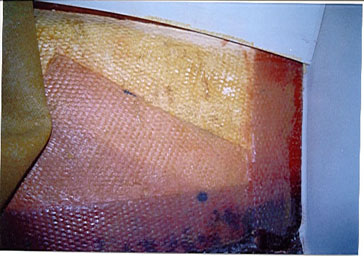
Photo #1.
This photo is taken in the forward cabin just above the point where the sole is taped into the hull sides and below the waterline. When I first lifted the carpet here, I was taken aback because my first impression was that the cabin sole tabbing had been laid over painted fiberglass, since the aft section of the interior hull was painted. As you can see, the tabbing is a pink color while the hull laminate seen at the top of the photo is not translucent like the tape but completely opaque. (Tape or tabbing are the strips of fiberglass used to join parts together, such as a bulkhead to the hull in this case.)


2.
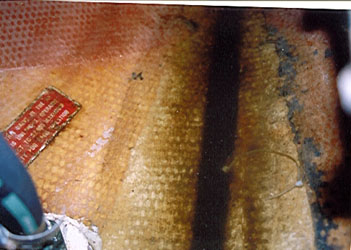
Photo #2.
This is one of  the most graphic illustrations you will ever see  of differing rates of water absorption in various areas of one hull. This is looking straight down at the centerline bilge in the forefoot where a bit of black water lies at the bottom of the vee (the black vertical line). The yellow section at the center is a separate layer of fabric which has absorbed far more water than the surrounding laminate and turned yellow. Whereas in the upper part of the photo, you can see a different layer of fabric that is pinkish and is not as opaque, meaning that it has absorbed less water.. Notice that the coloration is the exact opposite of that in photo #1, where it is only the tabbing that remains pink and translucent. Since both sections of laminate are equally hard, most likely what this is telling us that two different kinds of resin were used in this lay up. Because of the hardness, cure rate does not seem to be a factor as it is in many cases.


  3.
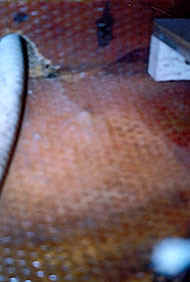
Photo #3.
This photo was taken a few feet further aft. it's the hull bottom between the keel and the stringer (top of photo). Here the laminate has a blotchy appearance - its whiter toward the left and center, while a more translucent area is seen at right. At the bottom is an oily bilge high water line. The stringer has absorbed very little water and remains translucent, whereas the bottom laminate has turned opaque.  The differing colors, which are not just surface contamination, suggest that chemicals in the bilge water have also played a role in the discoloration.

What is most distinguishing about this photo (#3) is the progressiveness in the change of color of the laminate down toward the keel; the deeper in the bilge, the more opaque the laminate. When a laminate, or plastic, absorbs water it turns cloudy or opaque. We take this as clear evidence of just how much water a hull can absorb from the interior.

Go to Article

First Posted in 1997 at David Pascoe's site www.yachtsurvey.com.

Post: June 16, 1998 , Last reviewed 11/28/98


About Author:

David H. Pascoe is a marine surveyor, author and publisher of power boat books:
"Mid Size Power Boats", "Surveying Fiberglass Power Boats" 2E, "Buyers' Guide to Outboard Boats" and "Marine Investigations".

For his business and contact information, visit  www.yachtsurvey.com

Chapter 1   
What is Pre-Purchase Survey?
Chapter 2   
Business Practices and Client Relations

Chapter 3   
Sound vs. Seaworthiness

Chapter 4   
Procedures

Chapter 5   
Hull and Its Structure

Chapter 6   
Surveying the Hull
Chapter 7   
Using Moisture Meters

Chapter 8  
Stress Cracks & Surface Irregularities

Chapter 9   
Deck & Superstructure

Chapter 10   
Cockpits

Chapter 11 
Drive Train

Chapter 12 
Gas Engines

Chapter 13 
Fuel Systems

Chapter 14 
Exhaust Systems

Chapter 15 
Electrical Systems

Chapter 16 
Plumbing Systems

Chapter 17 
Sea Trials

Chapter 18 
Appraisal

Chapter 19 
Reporting

480 pages


Chapter 1 
The Marine Investigator
Chapter 2

The Nature of Investigations
Chapter 3  
The Nature of Evidence
Chapter 4 
Marine Insurance and Issues of Law
Chapter 5  
Bilge Pumps & Batteries
Chapter 6  
Finding the Leak
Chapter 7  
Sinking Due To Rain
Chapter 8  
Fire Investigations
Chapter 9  
Machinery Failure Analysis
Chapter 10
Fraud Investigations
Chapter 11
Interrogation Techniques
Chapter 12
Reports
Chapter 13
Deposition & Court Testimony

544 pages


TOP

marinesurvey.com Online Articles Home


Buyers' Guide  to
Outboard Boats

for Open Water Boating
P
a
s
c
o
e
Mid Size Power Boats
Cruiser Class Boats
B
O
O
K
S
Surveying
Fiberglass Power Boats
 2E
Marine Survey Business
P
a
s
c
o
e
Marine Investigations
Expand Marine Survey Business


Boat Buyers and Owners

Marine Survey Related Photo Library Books Book Order Contact Us


Copyrights ©1996-2011 D. H. Pascoe & Co., Inc. All Rights Reserved.
Destin, Florida