


Professional Marine Surveys
David Pascoe
Marine Surveyor
Professional Marine Surveys
- Hull Design Defects - Part I
- Hull Design Defects - Part II
- Surveying Boats With Molded Integral Grid Systems
- Surveying Wood Hulls
- Avoiding the Blister Blues
- Sinking of EL TORO II
- Storm Damaged Boats
- Insurance Surveys and Reports
Browse Articles
Hull Design Defects Part I
This series of articles is written exclusively for marine surveyors to help identify the wide range of structural defects that can be found in boats and yachts. Because there is such a diversity in types of hulls, design styles and an ever-expanding array of new construction materials, it is difficult for surveyors to keep up to date on cause-and-effect evaluations. (text 39k + 7 photos, Hull Design Series: First article)
Hull Design Defects Part II
Anyone who has ever seen airframe construction, particularly jet aircraft, understands why aircraft can be built with skins that are extremely thin. And while an aircraft isn't subjected to the same type of forces as a boat hull, the fuselage is the hull and must be strong in different ways. Rather than being framed, one could correctly say that an airframe is corrugated, for that's exactly what it is. The skin can be extremely thin because the frames are so close together...(text 49k + 9 photos, Hull Design Series: Second article)
Surveying Boats With Molded Integral Grid Systems
Fiberglass boats built with internal liners
have been around for a long time. Typically, a liner is a
premolded internal component, the purpose of which is to provide
the basis for the interior layout. Over time, this function
has evolved and has slowly taken over the function of providing
internal hull structural support as well.
Surveying Wood Hulls
This essay proposes to fill the alleged gap
by offering a general discussion of how to approach the survey
of a wood hulled vessel.
Now that I have roundly criticized the Coast Guard for their
role in the EL TORO II tragedy, it's only fair that I should
offer some effective solutions on how to prevent these casualties
in the future. I fully recognize that it is easier to be critical
than to solve the problems being criticized. Yet, in the EL
TORO II tragedy, a wooden vessel which sank and killed three
people because of wasted hull fasteners, the NTSB and the
Coast Guard blamed a lack of "adequate guidance"
for the CG's failure to locate these faulty conditions on
EL TORO.
Avoiding the Blister Blues
Good Detection and Communication Techniques
Critical to Avoiding Complaints
Hull blistering is a problem that has been with
us for a quarter-century. One might think that over a period
of twenty-five years this problem would have long since been
solved, and no longer be much of a problem for surveyors.
Unfortunately, our research reveals that the blistering of
boat bottoms continues to be a growing source of complaints
and lawsuits against surveyors. It seems to be one of those
pernicious problems that just won't go away. In fact, the
number of lawsuits against surveyors has actually increased
dramatically in the last several years.
Sinking of EL TORO II
An Independent Review of
the Coast Guard Investigation Report
On December 5, 1993 the party fishing vessel
EL TORO II sprung three planks and sank 5 miles south of Point
Lookout on the Chesapeake Bay. There were 23 passengers aboard
and three died in the incident, mainly due to exposure to
the cold bay waters.
The EL TORO is a story of particular interest to marine surveyors
that reveals some hard-learned lessons. EL TORO was a Coast
Guard certified passenger carrying vessel that had just undergone
its drydock inspection on March 23, 1993, little more than
8 months prior. In addition, an insurance survey was completed
just 5 days before the loss of the EL TORO. Both of these
are factors which will come into play, as we shall soon see,
that provide some very important lessons for surveyors.
Storm Damaged Boats
Since Hurricane Andrew in 1992, the eastern U.S. has been hit with 7 hurricanes that have caused damage to tens, if not hundreds of thousands of boats. This means that there is nearly an equal number of boats that have been repaired and put back on the market. In itself, that would not be a problem, except that so many of these damaged boats were sold as salvage to speculators who then made substandard repairs and put them back on the market.
Insurance Surveys and Reports
The Insurance survey, Condition and Value survey or C&V as it is often referred to, is a type of survey intended for use by insurance companies for evaluating whether or not they wish to insure a particular vessel. The insurance industry has never set a standard as to the nature and extent of information that they require and so surveyors have largely been left to guess at the kind of information that different insurance companies want. This guide will assist the surveyor in identifying the most appropriate information to be covered in the survey and report.
HOME > Marine Survey Related


Over 180
Online Articles by David Pascoe

Power Boat Books
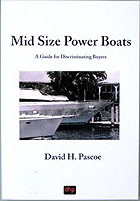 Mid Size Power Boats
 A Guide for Discriminating Buyers
Focuses exclusively cruiser class generally 30-55 feet
With discussions on the pros and cons of each type: Expresses, trawlers, motor yachts, multi purpose types, sportfishermen and sedan cruisers.
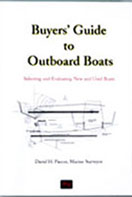
Selecting and Evaluating New and Used Boats
Dedicated for offshore outboard boats
A hard and realistic look at the marine market place and delves into issues of boat quality and durability that most other marine writers are unwilling to touch.

2nd Edition
The Art of Pre-Purchase Survey The very first of its kind, this book provides the essentials that every novice needs to know, as well as a wealth of esoteric details.

Pleasure crafts investigations to court testimony The first and only book of its kind on the subject of investigating pleasure craft casualties and other issues.