

Corrosion in Marinas
The Hot Dock
by David H. Pascoe, Marine surveyor
You keep your boat in a
crowded marina and there's a lot of talk about corrosion and bad wiring. It's
all the marina's fault, right?
Not necessarily, and the reason why is due to a general lack of understanding of what happens in a marina full of boats. After all, this is not an easy thing to understand, and it took a lot of research to find out what was going on here. Yes, the marina's wiring is involved with all such corrosion problems, but it may or may not be the cause.
- Introduction
- The Boat Battery
- The Long and Short of it
- Sea Water Versus Fresh
- Solutions
- Your Equipment
- Reverse Polarity
- Battery Chargers
- Extension Cords
- When Traveling
- Small Boat Marinas
- Answers to Common Questions
- Summary with one illustration
Contents
The key to understanding corrosion problems in marinas involves several things. First, all the boats in the marina are tied into the marina's grounding system. Second, all the boats are also grounded at a second source -- the water.
Thirdly -- a major point here -- the AC power system on the boat (green wire) is also grounded to the boat's common ground point, usually established at the engines. This means that your boat's common grounding and bonding system is electrically connected with the dock's grounding system.
Before we get any further into this, let's be sure that we understand our terms here. The 125 VAC shore system has three wires (except for 125/250 VAC which has four), one of which (black) is obviously the current carrying conductor. The others are the ground (white), or neutral, and the grounding wire (green), which is the safety ground intended to deal with short circuits and protect people from electrical shock. Also called a "bond," it is attached to the frames of all appliances and other electrical devices. The ground, which is the negative (-) side of the system, is supposed to be at earth potential, but this is a normally current carrying conductor, whereas the grounding wire isn't.
Anodic means that a metal is less highly charged than others. Stray current will seek a path to an anode, and from there travel to ground, the water. When an anode is energized by an outside source, as the electricity leaves the anode, it carries molecules of metal away with it. This electrical erosion is true electrolysis. Cathodic means that a metal is more positively charged; current will flow from it, and on to one that is anodic, with no resulting metal loss or erosion. Thus, with a zinc attached to a stainless shaft, the zinc erodes while the stainless is protected. Adding an outside source of current accelerates the process.
Galvanism, or galvanic current, is caused by dissimilar metals, metals with a greatly different electrical potential that are electrically joined. Galvanism plays the primary role in the "boat battery" problem described below.
The Boat Battery
Next, consider that all the boats in the marina are connected together electrically by both of these wires, the neutral and the ground or bond, one of which is also joined to the underwater metals of the boat (the bond). The boat's neutral is never grounded to the boat itself, but always earth potential of the dock ground. The underwater metals of the boats, of course, can vary between such things as brass, bronze, stainless steel -- and aluminum, as in outboard motors, aluminum boats and stern drives. All of these metals can develop different electrical potentials galvanic ally in the same manner as a battery does.
We could have, for example, ten boats on a pier all in a row, and all tied together via these ground systems. Each boat in this chain creates a galvanic "cell," just as the plates in a battery does. The average inboard boat develops about ? volt or less via its submerged metals, so that ten boats connected together has the potential to develop 5 volts since cells in series increase overall voltage in a line by the value of each cell.
Electricity is obsessed with finding a path to ground and will always do so. It will follow the path of least resistance. If the 5th boat in the row were an aluminum stern drive boat, as shown in the illustration below, what do you think would happen? Yes, all those boats with bronze and stainless parts on the bottom, which are far more noble than aluminum, are going to set up a nifty little battery with the stern drive or aluminum boat as the sacrificial anode! The inboard boats will do just fine, but the stern drive or aluminum boat will see its drives or hull damaged or destroyed.
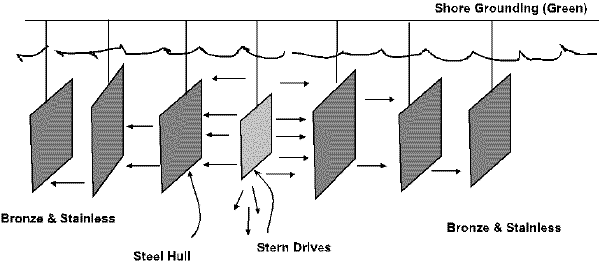
Click for larger drawing.
Much the same thing can happen to boats that underwater metals of inferior alloys such as low grade bronze or stainless steel such as the kind that often comes from the orient. Boats with cheap "active" alloyed metals are going to be anodic to those with high quality passive alloys. Alloys are often termed as active or passive based on the amount of alloying metal that raises or reduces its electrical potential. Only passive metals should be used on boats. Aquamet 22 stainless shafts are passive, whereas other alloys may not be, or less passive.
What we have then is a veritable "boat battery" where each boat on the circuit acts like a battery plate. So it is that this has nothing to do with the dock's wiring, though the marina often gets blamed for these problems.
The Long and Short of it
Unfortunately, this is only the beginning of the electrical problems experienced in marinas. From here, it gets quite a bit more complicated. Let's use our aluminum stern drive boat again as an example. Let's say this little beauty is really hot. Or maybe it's an aluminum hulled boat. Again, it's connected to all the other boats via the grounding wire. So the current that it is generating is also being fed back into the docks grounding system, and affecting all the other boats in the chain. Would that be the boats upstream or down stream on the wire circuit? See what I mean? It gets complicated.
The size of the immersed metal, and the distance upstream or downstream on the grounding circuit has a lot to do with it. A larger area of metal will dissipate current to the water with far less corrosion damage than a smaller area of metal. This is because of resistance in the metal that disperses the energy over a wider area. Yet the very same thing happens over a distance of wire. The longer the wire, the more resistance in it. The boat out on the end of the pier is at the end of a very long wire, so it has a less effective the ground because there is more resistance in it.
This can translate to good news or bad news, depending on the electrical potential of your underwater metals. Keep in mind that sea water is also a grounding source. It's bad news if the resistance on the dock is high enough to cause the sea water to become the ground path. This will happen if the resistance in the dock ground is greater than that of the water, and your metals are incompatible. The increased electrical potential in the circuit has now caused them to become highly anodic. Oddly enough, this may actually help our stern drive boat as the increased resistance in the line makes it less anodic, but probably not that much. Because the amount of surface area of metals plays a role, it will likely be small boats mixed with large boats that will experience the greater degree of corrosion.
The grounding wire is supposed to be at earth potential. If it's being charged, then it's not at ground potential. It has become a current-carrying conductor, meaning that all the boats on the dock are experiencing more impedance in the ground circuit. This is going to hurt the boats upstream, but help the boats downstream. Here's why: the resistance in the line reduces the current flow to earth, thus causing underwater metals to become anodic. This is because our dock wire is not the only ground source; a boat in sea water is also grounded via the water. When the resistance in the wire exceeds that of the water, the water then becomes the ground path. The longer the wire, the greater the resistance, so the end boats are most affected. When the water becomes the ground, the underwater metals become anodic.
This is when the general corrosion problems start. It will first attack the weaker or less noble metals such as zinc and aluminum until they disappear. If you have a sea cock, perhaps a gate valve that came from a plumbing supply store that is a poor alloy, or the wrong alloy fasteners holding things on the bottom, then these items will go next. By this time, your problem will have announced itself loud and clear as serious leaks develop.
Sea Water Versus Fresh
Sea water always presents a more serious problem, right? Wrong. In most cases it does, but there is one important exception. Fresh water is more resistive by a factor of around 70:1 With the second ground potential (fresh water) substantially lessened, the problem comes about when the dock wiring is defective, when the ground and bonds have high resistance due to corroded connections, etc.
The problem with electrical shocking is heightened when things like metal framed floating docks are involved, which provide yet a third grounding source. It is the difference in potential between these two or three grounding sources that causes our problems. If the potential within the boat's metallic systems is greater than the grounded neutral, then sea water will become the ground. If in fresh water, you may end up getting shocked when touching metal parts on both boat and dock. The current flow is going to be between your body and the dock. Therefore, stray current can be more serious in fresh water than salt because of poor grounds on the dock.
As you can see, the issue of corrosion problems in marinas can be complex, and even more difficult to solve from the marina end. You probably find all this very confusing. Well, you're not along. So do I. In fact, probably no one understands it fully, but fortunately there are simple solutions.
Faults in the dock wiring should be corrected, of course. Yet as we have seen, this may be only part of the problem. The only reasonable solution for the marina "boat battery" problem (if you have one) is to use galvanic isolators on the shore power system of the vessel. Transformers eliminate direct electrical contact by transferring electricity magnetically. Some of the more high end marinas these days that cater to large aluminum yachts have such transformers on the dock. This is very expensive since there's also a great deal of power loss with transformers, so you won't find many -- if any -- marinas catering to smaller boats like this. It's up to you, the boat owner, to protect yourself.
For small boats with aluminum drives, galvanic isolators are available that work only with the grounding circuits, and not the main power feeds. These are okay for boats that are only running something like a battery charger on AC current. For larger boats with higher power demands, it is necessary to have a full sized isolation transformer.
In case you've heard of that crazy solution of disconnecting your green, grounding wire, consider that quite a few people have been electrocuted as a result of this half-baked idea. The green is there to protect people against electric shock and electrocution, so don't defeat its purpose.
Your Equipment
If the dock system takes a beating, how about your own equipment, like the connectors on your shore cord and boat? When was the last time you opened them up and inspected the condition of these things. It is very common for shore connections to get wet and corroded, both on the male and female connectors, and at the wire connections to the prongs within the connector head. Corrosion and damage at these points not only interferes with grounding potential, but also is one of the largest causes of fires on boats. High resistance connections in the power feed causes overheating that can start fires. This equipment should be serviced at least annually, depending on the amount of use it gets.
Corrosion on the grounding connectors cause faulty grounds on your boat which is very damaging to electrical equipment. Do you know why people so often replace refrigerators and air conditioning compressors on boats? Yep. Faulty grounds (the neutral) wreck compressors. Refrigerators at home last forever, but not on boats for this reason.
Reverse Polarity
This common problem is one that should be thoroughly understood by all boaters. Reversed polarity can exist on the dock or within your own boat, which should be equipped with a reverse polarity indicator light on you main electric panel. Regardless of whether the reversing point is on the dock or in you own boat, this is going to energize the neutral ground and create an electrical shock hazard. It will not find its way into your bonding system because these circuits should never be joined. Most experienced boaters keep a small polarity tester handy and use it occasionally just to be sure. It's a wise thing to do, especially if you ever run power tools off a dock outlet.
Battery Chargers
Automotive battery chargers are a common cause of corrosion in boats, particularly small boats without shore systems. Auto chargers often provide no isolation between the ac and dc windings and can energize the negative terminal, which also energizes the boats grounding system. Portable auto chargers should not be used on boats, and are a frequent cause of stern drive damage.
Extension Cords
Extension cords should not be used on board boats. Period. Unless it is equipped with a ground fault current interrupter, or plugged into an outlet so equipped, and then only for temporary use of power tools. Why not? Because of the acute electrical shock hazard that accompanies the basically unprotected connector. Get some water in the connection and these things short across the terminals to energize all circuits, including the protective (green) bond.
When Traveling
Fortunately, more and more marinas have become aware of the dangers of faulty dock wiring, and there are far fewer with bad systems these days. As you may have noticed, marina electrical facilities take a beating and quickly degrade. If the power outlets just look bad, they probably are. If outlets are damaged and exposed to weather, if you find circuit breakers broken or missing, damaged or wasted conduits (Look on the underside of the dock). Are there wires and conduits hanging down, maybe in the water?) If so, then take a pass and don't connect up there.
If you're skilled in the use of a voltmeter, one thing you can do is to measure the current flow between your boats grounding system and the dock grounding system. Which way is the current flowing, and how much is it? Your boat is safe if the reading is on the positive side with red lead to the boat, black to dock. If it's reversed, and you're getting more than 1/2 volt, you shouldn't stay connected to if for very long. 1/2 volt is common, but if it reaches up towards 1 volt, there will be an overnight affect on your zincs. In a week, they can disappear.
If you have an aluminum boat, or a boat with stern drives or outboards that is connected to shore power in a marina, consider it a must to have an isolation transformer installed.
Small Boat Marinas
These tend to be the worst offenders, where inexperienced owners will do some of the craziest things. It's not uncommon to see boats connected with extension cords, or unprotected three-prong male connectors and adapters which, when they get wet short across the terminals. Lacking installed battery chargers, they use portable automotive chargers, connected to extension cords. I've even seen people take extension cords and splice a male connector on the female end and plug it into a receptacle on the boat! Be extra wary of electrical faults at these marinas.
Answers to Common Questions
How about a stern drive boat with a shore power system at a private dock? If the wiring system is good, then you shouldn't have a problem with it. When in doubt, have the impedance of the ground checked to be sure that the boat isn't the ground source rather than the dock. This is simple and inexpensive to do.
If the zincs on your boat are disappearing very rapidly, at a rate which leaves shiny, instead of oxidized metal, you should suspect both the dock wiring and other boats on your dock. The question becomes who is the culprit and what can be done about it. Rates of zinc loss are normal when a layer of oxide develops on the zinc, not when pits appear that leave bright or hard metal with no oxide. Rates of zinc loss are not predictable in terms of time as there is a wide range of factors involved.
Does current travel through the water from boat to boat? No, it doesn't. Only via the grounding system.
Despite the complexity of the issue, boats with galvanically compatible underwater metals usually will not be affected (unless the problem is extreme), while the ones with lesser compatible metals, the ones that become anodic, suffer the consequences. Oriental boats with a lot of submerged and questionable stainless steel and poor quality bronze propellers are often victims as these metals are active rather than passive, and often contain impurities in the metal that further adds to the corrosion problem.
Can a boat with a stray current problem affect those nearby? Yes, but. Remember that all our boats are wired together. Assuming that the ground connections to each boat are solid, but the dock ground isn't, then the grounding wire is going to be energized. High resistance in the bond will feed current back into all boats with good connections, those without isolation transformers. Again, because distance and surface area of metals dissipates current, those closest are most likely to be affected.
What about marinas with shorts in the system? Won't they cause corrosion on my boat? In the case of marinas with short circuits in the wiring, usually someone is going to get badly shocked, in addition to which there will be a power drop that will affect everyone. This sort of thing usually gets discovered rather quickly as electric equipment doesn't function properly and the circuit breakers start popping.
What happens when there is a fault in the neutral ground? Your lights are dim and electrical appliances run slower, and eventually burn up. You will get lower readings when you measure the voltage.
Will my panel meters reflect the problem in any way? Usually not, although if there is a ground fault you may get lower voltage readings.
What is a cathodic protection system, and what about them? These systems protect a boat's metal hull by using an electrified anode. The problem with these things is that when something goes wrong with the system, they can end up destroying the hull rather than protecting it. This can also affect other boats nearby. It's not a reasonable solution and is not recommended.
In summary, the "hot marina" is really either one that has faults in the grounding system, or one or two boats in an electrical series that are galvanically deficient. If it's your boat that is suffering the damage, most likely it's your boat that is the offender. This is why usually only a few boats on the pier are affected, and not all equally.
This describes but a few, but most significant factors involved. There can be all sorts of unusual conditions that can make discovery of the problem very difficult. On the other hand, if you install a galvanic isolator, at least the corrosion problems won't be yours. Whether you need isolators depends on the conditions where you keep your boat.
* * * * * * *
References: Your Boats Electrical System, by Conrad Miller is probably the best and most comprehensive text on the subject and is usually found at all marine bookstores and outlets. It covers virtually all subjects and no boat owner should be without it. Even if you don't read it cover to cover, you'll find it a very useful reference.
American Boat and Yacht Council Safety Standards for Small Craft provides extensive specifications for all types of boat electrical systems. Contact ABYC at 410-956-1050.
See also our article on Corrosion (with 9 photos).
First posted January 7, 1999 at
www.yachtsurvey.com.
Page design changed for this site.
Posted July 12, 1999


Over 180
Online Articles by David Pascoe

Power Boat Books
 Mid Size Power Boats
 A Guide for Discriminating Buyers
Focuses exclusively cruiser class generally 30-55 feet
With discussions on the pros and cons of each type: Expresses, trawlers, motor yachts, multi purpose types, sportfishermen and sedan cruisers.
Selecting and Evaluating New and Used Boats
Dedicated for offshore outboard boats
A hard and realistic look at the marine market place and delves into issues of boat quality and durability that most other marine writers are unwilling to touch.

2nd Edition
The Art of Pre-Purchase Survey The very first of its kind, this book provides the essentials that every novice needs to know, as well as a wealth of esoteric details.
Pleasure crafts investigations to court testimony The first and only book of its kind on the subject of investigating pleasure craft casualties and other issues.